Tricky Vic: The Impossible True Story of The Man Who Sold the Eiffel Tower

                                    TrickyVic

Tricky Vic: The Impossible True Story of the Man Who Sold the Eiffel Tower
by Greg Pizzoli
Viking, 2015.  39 pgs. Biography

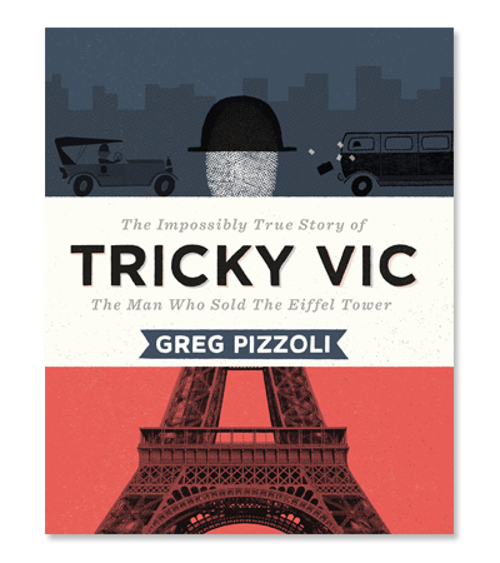
     Robert Miller was born in Czechoslovakia (now the Czech Republic) in 1890. He was smart, did well in school, and looked to have a bright future as he pursued a degree at the University of Paris. Instead, "he left home to become 'an artist.' A con artist." At first he made his living as a professional gambler. When he got into trouble at the poker table, he took to the seas, and he took a new name: Count Victor Lustig, so he could mix with rich people and relieve them of their valuables. In the United States he even conned Al Capone who gave him his blessing to move around Chicago selling a fake money-making machine. When the States got too hot, Count Victor went back to Paris where rumors of the demolition of the Eiffel Tower allowed him to "sell" the structure to a Monsieur Poisson (the fish). Too embarrassed to call the police, Poisson lost his savings to Tricky Vic who went back to the United States where he was arrested on a counterfeiting charge but escaped jail by pretending to be a window washer, though he finally was caught and sent to Alcatraz. Tricky Vic, though certainly not a role model, was a master of his craft and his story, along with Pizzoli's charming illustrations (Count Victor's face is always a fingerprint), should interest and delight both young and old.

Comments

Popular posts from this blog

Review: The Factory

The Factory By Catherine Egan New York, NY : Scholastic Inc., 2025. Fiction. 306 pages.  Thirteen-year-old Asher Doyle has been invited to join the Factory, a secretive research facility in the desert which ostensibly extracts renewable energy from the electromagnetic fields of its young recruits. But Asher soon realizes something sinister is going on. Kids are getting sick. The adults who run the Factory seem to be keeping secrets. And the extraction process is not only painful and exhausting, but existentially troubling. Asher makes a handful of new friends who help him with an investigation that turns into a resistance, which turns into...a cliffhanger! The Factory is a page-turning sci-fi with multidimensional characters, an intriguing plot, and refreshingly straight-forward writing. Egan weaves in detail about climate crises and social unrest, making the story's dystopian setting feel rich and plausible. With its sophisticated themes and accessible storytelling, I would recomm...

Review: Fowl Play

  Fowl Play By Kristin O'Donnell Tubb New York: Katherine Tegen Books, 2024. Fiction 277 pages. Still reeling from her beloved uncle's death, Chloe Alvarez is comforted and confused when at his last will and testament reading, Uncle Will gifts her his African Grey parrot, Charlie. Charlie has a robust vocabulary and loves to make Alexa requests for her favorite songs, but when she starts saying things like, "homicide," and "cyanide," Chloe becomes convinced that Uncle Will may have met his demise by murder instead of a genetic disease, as was previously thought. Ultimately, bringing in her brother, Grammy, and Uncle Frank (and of course Charlie,) Chloe's ragtag and adoring family support her search for answers ---going on stakeouts, engaging in fast pursuits, and searching for clues. But as the suspects stack up and the mystery grows, Chole will learn that the process of death and grieving is complicated, and in the end her Uncle Will's words that, ...

National Geographic Book of Animal Poetry

National Geographic Book of Animal Poetry Edited by J. Patrick Lewis National Geographic, 2012, 183 p. Poetry In this beautiful poetry collection, the National Children's Poet Laureate, J. Patrick Lewis, has teamed up with the amazing photographers at National Geographic. The result is 200 poems about animals, all illustrated with stunning nature photography.  The poems are well chosen and include rhyming, free verse, and shape poetry. Some of the poems are funny, many are contemplative and all are nicely typeset on top of the full color photographs. One of my favorites is a shape poem about flamingos, with a photograph of a flock of flamingos which seem to be standing the the shape of a flamingo (how did they do that?).  Lewis ends the collection with a brief but interesting section about writing animal poetry.  This selection is sure to turn any animal lover into a poetry lover.